Your Best Ideas Aren't Coming From Your Desk
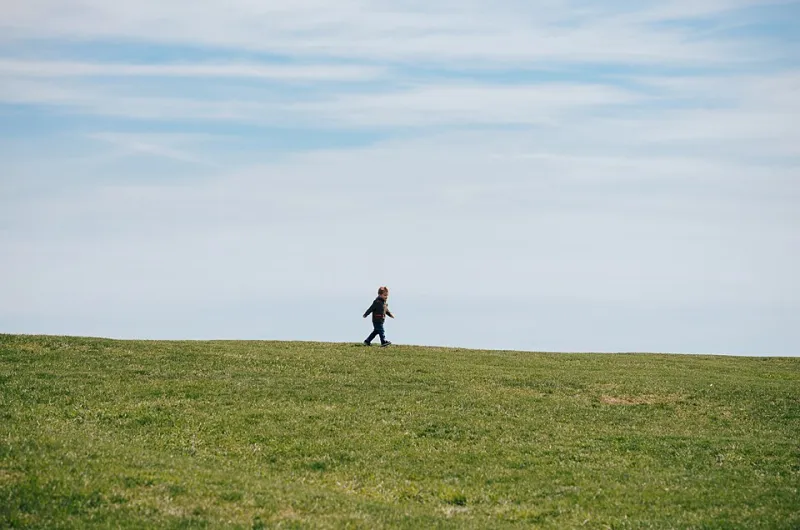
Photo: Kelly Sikkema kelsikkema, CC0, via Wikimedia Commons
You've had the idea already. It arrived in the shower, or pushing a cart through the grocery store, or three blocks into a walk you almost didn't take because it wasn't on the schedule. It did not arrive at your desk. It never arrives at your desk.
That's not a coincidence, and it's not a moral failing of your work ethic. It's a structural feature of how attention works, and most of us have spent the last decade building lives that systematically eliminate the conditions that produce it.
The Focus Conversation Has a Blind Spot
We've gotten very good at talking about focus. We have apps that block apps, calendars segmented into twenty-five-minute bricks, noise-canceling headphones, and an entire genre of advice about "deep work." Focus is genuinely valuable. It's just not the only setting your brain has, and we've started acting like it's the only one that counts.
Think of attention as a spotlight. It's brilliant at illuminating one thing at a time — that's what makes it useful when you're balancing a budget or learning a new system. But a spotlight has a narrow beam, and everything outside it goes dark. If all you ever do is point it at tasks, you'll only ever see what you already pointed it at.
The other mode is different. When you stop directing your attention, the brain doesn't shut off. It keeps working — just not on what you told it to. It starts connecting things sideways: last week's conversation, a half-remembered article, a problem from a completely unrelated project. This is the mode that hands you the idea in the shower, and it doesn't run on command.
Two Settings, One Brain
Neuroscientists have a name for that background mode — the default mode network. For a while it had a bad reputation, mostly because it was first studied in the context of rumination. And yes, the same machinery that produces insight can also produce a two-hour loop about a passive-aggressive text. Same equipment, different direction.
But the picture is more balanced than the early headlines suggested. When your attention is undirected, your brain is still integrating — pulling together memories, drawing associations, testing scenarios. This is why the solution to a problem often shows up while you're doing something else entirely. The work didn't stop because you walked away from the desk. It just moved to a different room in your head.
Researchers call it incubation, and it shows up reliably in studies where people who step away from a hard problem outperform people who grind on it without a break. You probably have personal evidence. The breakthrough usually doesn't come during hour three of staring; it comes in the parking lot.
The Shower Effect Is Real, and It's Not About the Shower
Somebody has probably told you that showers make you creative, and the explanation offered is usually something about warm water or steam. The actual mechanism is less romantic. A shower is a low-demand environment with mild, pleasant stimulation — enough to keep the body occupied, not enough to require your attention. Your mind is free to wander, and wandering is what generates the connections.
The same is true of walking, driving a familiar route, washing dishes, folding laundry, or standing in line at the pharmacy. Not magic. Just unstructured.
The Catch: Aimless Is Harder Than It Sounds
Here's where it gets inconvenient. We've gotten very good at eliminating those gaps. Waiting in line for ninety seconds, we reach for the phone. Walking to the car, we queue up a podcast. Folding laundry, we put on a show. Every undirected minute gets filled, and we do it so reflexively that we don't experience it as a choice.
Part of the reason is that unstructured time is genuinely uncomfortable. Boredom is an aversive state, and research suggests it nudges us toward either seeking novelty or restoring a sense of purpose. A phone satisfies the first option in about four seconds. But scrolling isn't boredom and it isn't daydreaming — it's a flood of tightly packed stimuli that keeps your attention fully directed, just at someone else's target.
So the empty minutes keep disappearing, and we keep wondering why our best thinking happens on vacation.
How to Leave Room Without Making It a Project
The fastest way to ruin this is to schedule an "insight hour." Aimless needs to be aimless, or it becomes another task to evaluate yourself against. Instead, try a few quieter moves.
Protect the transitions. The ten minutes between meetings, the walk from the train to the office, the first minutes of a drive home. Those are the seams of the day, and they're the most available place to let your attention off the leash.
Take one walk without audio. Not all your walks. One. Start with ten minutes and see how uncomfortable it is. The discomfort is information about how rarely your mind gets to drift.
Leave one errand unoptimized. Don't listen to the podcast while doing the dishes. Don't answer messages in the checkout line. Let one thing be dull and slow.
Keep a capture note. Ideas that arrive in the shower are frequently lost in the shower because you have nowhere to put them. A single note on your phone or a pad by the bed lets you catch the thought without spending the rest of the day rehearsing it.
Don't grade the output. If you start measuring how many good ideas arrive per walk, you've rebuilt the desk somewhere else. The whole point is that the returns aren't guaranteed, and demanding them kills the mechanism.
What Aimless Time Is Not
It isn't a replacement for focus. You still have to sit down and do the work; the shower doesn't write the report. It's also not rest disguised as a productivity strategy — this isn't "take a walk so you can crush your KPIs." The two modes are partners, not competitors, and neither one is a hack for the other.
So the next time you catch yourself pulling out your phone in an elevator, try leaving it there. You're not wasting time. You're giving your brain the kind of open space that most good ideas quietly require.