The Quantified Panic: How Wellness Metrics Became One More Thing to Fail
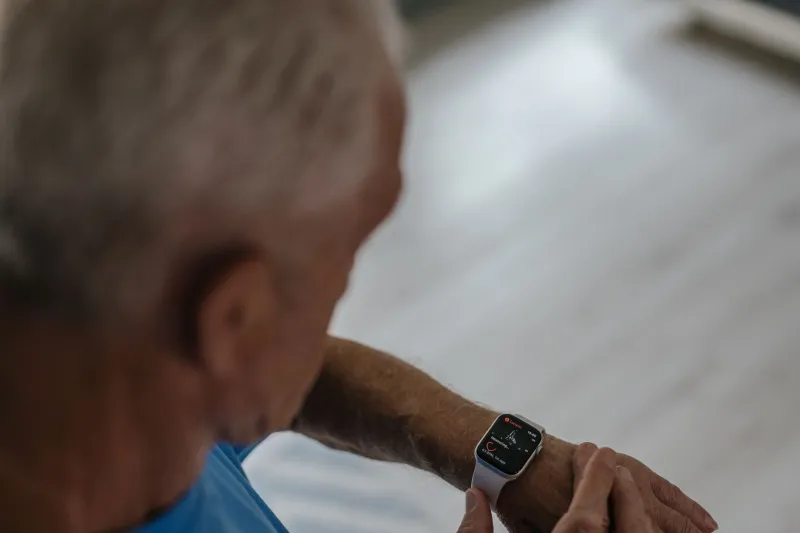
Most people who wear a smartwatch or a fitness ring have a version of this story. You're on the couch on a Sunday, half-watching a game, and your wrist buzzes: stress levels elevated. Nothing was wrong thirty seconds ago. Now something is, and the something is the notification.
That tiny sequence — device reads body, device labels body, person reacts to label — has turned into one of the more revealing unintended experiments in modern wellness. These tools were sold as insight. For a lot of people they've quietly become a second inbox, full of messages about everything they're getting wrong before 9 a.m.
A Condition That Needed a Gadget to Exist
In 2017, a team of sleep researchers led by Kelly Glazer Baron at Rush University Medical Center published a paper in the Journal of Clinical Sleep Medicine describing patients who had developed insomnia not from a sleep disorder but from their sleep tracker. The numbers said their sleep was bad. They believed the numbers. They started checking the app at 3 a.m. to confirm how bad it was. The authors gave the pattern a name: orthosomnia — the unhealthy pursuit of perfect sleep data.
Nearly a decade later, the same loop has spread from sleep to heart rate variability, stress scores, readiness, recovery, glucose, and a dozen invented indexes that mostly tell you whether a Tuesday was a Tuesday.
When Expectations Create Symptoms
The placebo effect gets all the press, but its grimmer twin is better documented than most people realize. Nocebo responses — real symptoms produced by the expectation of symptoms — show up reliably in clinical trials, which is part of why drug studies ask patients about side effects they haven't taken yet.
A stress alert is a small, well-timed expectation. It arrives as a red ring, a lowered number, a gentle nudge. Your brain reads the framing first and the physiology second. If the framing is "your body is struggling," it doesn't take much for the body to cooperate with the story.
Why a Red Ring Reads Like a Predator
Human beings are not great at tolerating ambiguity about the inside of our own bodies. Interoception — the sense of your internal state — is famously fuzzy. You can usually tell you're tired. You often can't tell why, or how tired, or whether it matters today.
A number collapses all of that uncertainty into something crisp. That's the appeal, and it's also the trap. Research on how people respond to self-tracking suggests the data quickly stops functioning as description and starts functioning as judgment, especially for anyone already prone to self-criticism. A score of 61 isn't a reading anymore. It's a grade.
From there, the nervous system does what it's built to do with grades: it watches for the next one. Vigilance is expensive. It narrows attention, tightens the shoulders, shortens the breath, and elevates the very physiological signals the device is measuring. The watch notices. The watch reports. The loop closes.
The Number Is Not the State
Here's the unglamorous technical reality: consumer wearables are excellent at measuring some things and shaky at measuring others. Heart rate? Good. Step counts? Good enough. Sleep staging and stress scores? Those are inferences built on top of limited sensor data, and studies comparing wearable sleep staging against lab polysomnography (the actual gold standard, with electrodes) have repeatedly found meaningful disagreement, particularly in lighter stages of sleep.
None of that makes the devices useless. It makes them approximations. An approximation of your night, filtered through an algorithm, displayed to a person who is tired, busy, and prone to worrying. Treating that as a verdict is like reading a weather app and deciding you're personally failing at the climate.
Three Questions Before You Act on a Reading
Useful data has a job. Unhelpful data has a mood. Before you let a score change your day, run it through three quick filters:
1. What would I have done differently if I'd never seen this number? If the honest answer is nothing, the number wasn't information — it was commentary.
2. Is this a trend or a Tuesday? One bad night is weather. Fourteen bad nights is climate. Single readings are close to meaningless on their own, and most apps present them without saying so.
3. Is the fix I'm about to do cheaper than the thing I'd have done anyway? Canceling a walk because recovery is low is expensive. Taking a walk because you feel like it costs nothing.
The Weekly Data Sunset
If you want a practice that reliably takes the edge off metric overload, try a 24-hour sunset once a week. Pick a day you aren't traveling or competing in anything. Take the watch or ring off, charge it in a drawer, and keep the phone out of arm's reach for the same window. Then, before bed, write one line in a paper notebook: what I noticed today with my body.
That's the whole protocol. It isn't a detox, and you're not making a statement about technology. You're just restoring a gap between sensation and interpretation — letting your nervous system remember that it can read itself, in its own rough, unquantified way.
The first few sunsets feel oddly blank. Many people report a low hum of anxiety, like they've left the stove on. That hum is the loop losing its grip. By week three or four, most people find the day becomes the one they actually look forward to.
Metrics are a flashlight, not a mirror. Pointed outward at a pattern, they can illuminate what your body genuinely needs — more sleep on training days, less caffeine after 2 p.m., an earlier wind-down on the nights before big meetings. Pointed inward as a running assessment of your worth as a functioning human, they just cast shadows.
The point of tracking was never to score yourself. It was to see yourself a little more clearly. The moment the dashboard becomes the judge, it's time to dim the lights.