Your Anxiety Isn't a Malfunction — It's Running on Old Software
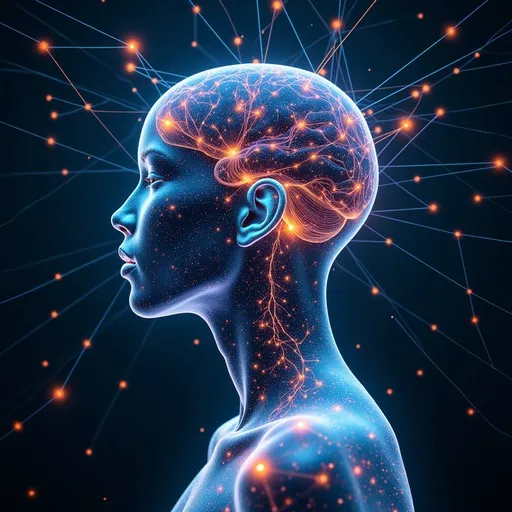
Photo: calm person breathing deeply with brain waves or neural network visualization in soft light, via images.stockcake.com
When Your Alarm System Won't Shut Off
Picture your brain's threat-detection system as a smoke alarm. In a house with an actual fire, it's life-saving. But when it blares every time you make toast, the alarm itself becomes the problem — not because it's defective, but because it can't tell the difference between smoke and steam.
That's modern anxiety in a nutshell. And once you understand why it works this way, you can stop fighting it and start working with it.
The Ancient Hardware Running Your Modern Life
Deep inside your brain sits a small, almond-shaped structure called the amygdala. It's been doing its job for roughly 300 million years, long before humans existed. Its entire purpose is to scan the environment for danger, trigger a stress response the moment it finds any, and keep you alive long enough to reproduce.
For most of human history, this was a fantastic arrangement. Threats were physical, immediate, and usually solvable by running or fighting. The stress response — that surge of cortisol and adrenaline, the racing heart, the tunnel vision — was perfectly calibrated to a world of predators and scarcity.
Then came the 21st century. Now your amygdala is processing Slack notifications, performance reviews, social media comments, and the vague dread of a global news cycle — and it's doing so with the same neurological urgency it once reserved for saber-toothed cats.
This is what evolutionary psychologists call evolutionary mismatch: your threat-detection hardware is running scenarios your ancestors never faced, and it doesn't have the context to know the difference between a tiger and a passive-aggressive email from your boss.
Why the Response Feels Disproportionate
One of the most disorienting aspects of anxiety is how big it feels relative to the actual situation. You know, intellectually, that a job interview is not going to kill you. You know the argument you're replaying at midnight is over. And yet your body is responding as if neither of those things is true.
That's not irrationality. That's your prefrontal cortex — the rational, planning part of your brain — being temporarily overridden by a threat response that moves faster than conscious thought. The amygdala processes emotional information about 80,000 times faster than your rational mind can respond to it. By the time you've thought, this is fine, I'm fine, your body has already been flooded with stress hormones.
Here's the part most anxiety advice skips: you don't need to eliminate this response. You need to recalibrate it.
Recalibrating, Not Deleting
The goal isn't a brain that never triggers anxiety. Anxiety is genuinely useful — it sharpens attention, motivates preparation, and signals that something matters to you. A life without any anxiety would actually be neurologically dangerous. The goal is a threat-detection system that's proportionate — one that fires when the situation warrants it and quiets when it doesn't.
Here's how to start tuning it.
Name It to Tame It
Neuroscientist Matthew Lieberman's research at UCLA found that simply labeling an emotional state — saying to yourself, I'm feeling anxious right now — reduces amygdala activation. The act of naming moves processing from the reactive limbic system toward the prefrontal cortex, essentially inviting your rational brain back into the conversation. It sounds almost too simple, but the neurological effect is real and measurable.
Try being specific. Not just I'm anxious but I'm anxious because I'm worried this presentation will make me look incompetent. Specificity gives your brain a concrete thing to evaluate rather than a vague threat to amplify.
Use the Body as a Reset Button
Because the threat response is physical, the most direct way to interrupt it is also physical. Physiological sighing — a double inhale through the nose followed by a long exhale through the mouth — has been shown in recent Stanford research to be one of the fastest ways to downregulate the nervous system. It's not glamorous. It works anyway.
Extended exhales in general activate the parasympathetic nervous system, which is essentially your body's counterweight to the stress response. Even a few deliberate slow breaths can measurably shift your nervous system state within seconds — not because you've convinced yourself to calm down, but because you've sent a physiological signal that the emergency is over.
Run the Threat Through a Reality Filter
Your amygdala doesn't deal in probabilities. It deals in possibilities. If something could go wrong, it treats that as equivalent to something that is going wrong. You can use your prefrontal cortex to do what the amygdala can't: assess likelihood.
When anxiety spikes, try asking: What is the actual worst-case scenario here? How likely is it, really? And if it happened, could I handle it? This isn't toxic positivity — it's a deliberate cognitive intervention that gives your rational brain something concrete to work with. Over time, running this filter regularly actually reshapes how your brain categorizes familiar stressors.
Reframe Anxiety as Information
Some of the most useful work in anxiety research right now involves shifting the relationship with the feeling itself. Harvard psychologist Alison Wood Brooks found that people who reframed pre-performance anxiety as excitement — rather than trying to calm down — performed measurably better. The physiological state is nearly identical; what changes is the story you tell about it.
Instead of treating anxiety as a problem to solve, try treating it as a message to decode. What is this feeling trying to protect me from? Is the threat real? Is it proportionate? When anxiety becomes a conversation rather than an alarm, it loses much of its paralyzing power.
Living With Updated Software
Recalibrating your threat-detection system isn't a one-time fix. It's an ongoing practice — the same way you'd update software regularly rather than expecting one patch to last forever. Your brain is plastic, meaning it genuinely changes in response to repeated patterns of thought and behavior. Every time you name the feeling, breathe through the spike, or run the reality filter, you're strengthening neural pathways that make the next response slightly more proportionate.
You're not trying to become someone who doesn't feel anxiety. You're becoming someone whose anxiety is finally working for them — sharp, informative, and appropriately sized for the actual moment at hand.
That's not a broken alarm. That's a well-tuned one.